In manufacturing, few terms are used as carefully, or as cautiously, as “virgin-equivalent.” For engineers, OEMs, and procurement teams working with high-performance polymers like PEEK, this phrase carries real weight. It suggests that a material performs at the same level as virgin polymer, meeting the mechanical, thermal, and wear requirements of demanding applications.
But in a market increasingly focused on sustainability, “virgin-equivalent” has also become a term that can be misunderstood or loosely applied.
At Drew Polymer, virgin-equivalent is not a marketing claim. It is a performance designation grounded in measurement, validation, and real-world application.
Why “Virgin-Equivalent” Requires Proof
High-performance polymers are selected for a reason. PEEK is used in applications where failure is not acceptable, environments involving high temperatures, chemical exposure, mechanical stress, and wear.
For that reason, engineers and decision-makers are rightfully skeptical of any material claim that suggests recycled or repurposed polymers can simply replace virgin material without evidence.
Virgin-equivalent performance must be demonstrated, not assumed.
This means moving beyond sustainability messaging and focusing on how performance is evaluated, measured, and validated over time.
What “Virgin-Equivalent” Is — and What It Is Not
Virgin-equivalent does not mean that all recycled or repurposed PEEK automatically performs the same as virgin polymer. Material performance depends heavily on sourcing, processing, and quality controls.
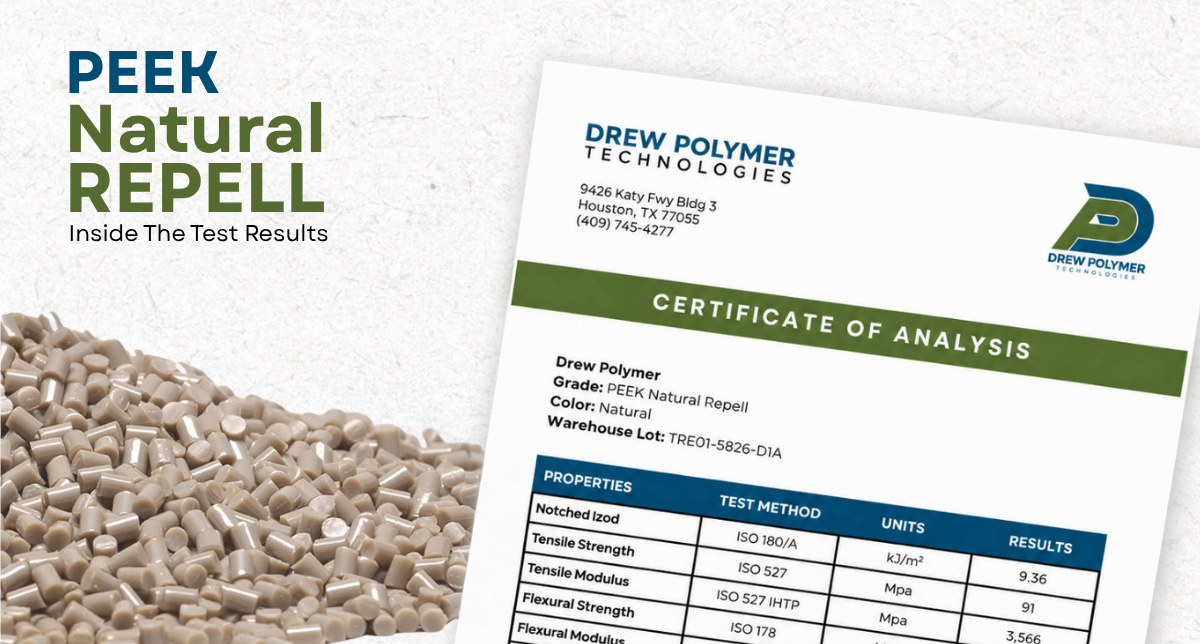
At Drew Polymer, virgin-equivalent refers to repurposed PEEK that is evaluated against key material properties and validated through real-world use. The term is only applied when performance data and application history support the comparison.
Just as importantly, virgin-equivalent is not used as a blanket label. It is application-dependent and performance-specific.
Key Properties Used to Evaluate PEEK Performance
Determining whether repurposed PEEK performs at a virgin-equivalent level starts with understanding which properties matter most for the intended application.
While requirements vary by use case, performance evaluation often focuses on:
Mechanical strength and stability
Wear resistance in dynamic applications
Thermal performance in elevated-temperature environments
Chemical resistance
Dimensional stability over time
These properties are critical in determining whether material performance remains consistent throughout service life.
Virgin-equivalent performance is established by measuring and comparing these characteristics, not by relying on material origin alone.
The Importance of Real-World Application Data
Laboratory data is important, but it is only part of the picture.
True performance validation happens in real-world applications, where material is exposed to actual operating conditions over time. Wear environments, load cycles, temperature fluctuations, and chemical exposure all play a role in how material performs beyond initial testing.
At Drew Polymer, repurposed PEEK is currently running in OEM wear applications with no measurable differences compared to virgin material after more than 18 months in service. This type of application history is essential to substantiating virgin-equivalent claims.
It demonstrates not just initial performance, but consistency over time.
Why Measurement Matters More Than Labels
In material selection, labels can be misleading. Terms like “recycled,” “repurposed,” or “virgin” describe origin not performance.
Engineers and procurement teams ultimately care about whether a material will meet specification, perform reliably, and reduce risk. That is why performance measurement matters far more than terminology.
Virgin-equivalent performance is determined by data, evaluation, and application success not by how material is categorized.
When Virgin Material Is Still the Right Choice
An important part of credibility is acknowledging limitations.
There are applications where virgin PEEK remains the appropriate or required choice due to regulatory requirements, qualification standards, or performance margins. Virgin-equivalent does not mean universal replacement.
At Drew Polymer, the goal is not to replace virgin material indiscriminately, but to provide repurposed PEEK as a validated option where performance supports it. This approach ensures that sustainability efforts do not compromise engineering judgment or application reliability.
A Data-Driven Path Forward
As sustainability continues to influence material sourcing decisions, manufacturers need clear, honest frameworks for evaluating alternatives to virgin polymers.
Virgin-equivalent PEEK represents a data-driven path forward, one where sustainability and performance are not treated as opposing goals. When material is measured, validated, and proven in real-world applications, repurposed PEEK can support both environmental objectives and demanding performance requirements.
At Drew Polymer, virgin-equivalent is not a slogan. It is a standard, defined by measurement, reinforced by application history, and guided by performance first.